
“Viy is the colossal creation of the common folk’s imagination.” — Nikolai Gogol
I first came across Viy almost by accident. Eureka Entertainment had just released a remastered DVD, and I caught a small mention in Sight & Sound. At the time, I was on the lookout for a new live cinema project — something different, something with a story behind it.
We’d already dipped into the territory of re-scored silent films. In fact, we’d gone all-in on Metropolis once, pairing it with a live Pink Floyd tribute band. It worked, but silent films have been done to death on the re-score circuit. What I wanted was a film with dialogue, but one strange and rich enough to take on a new sonic life.
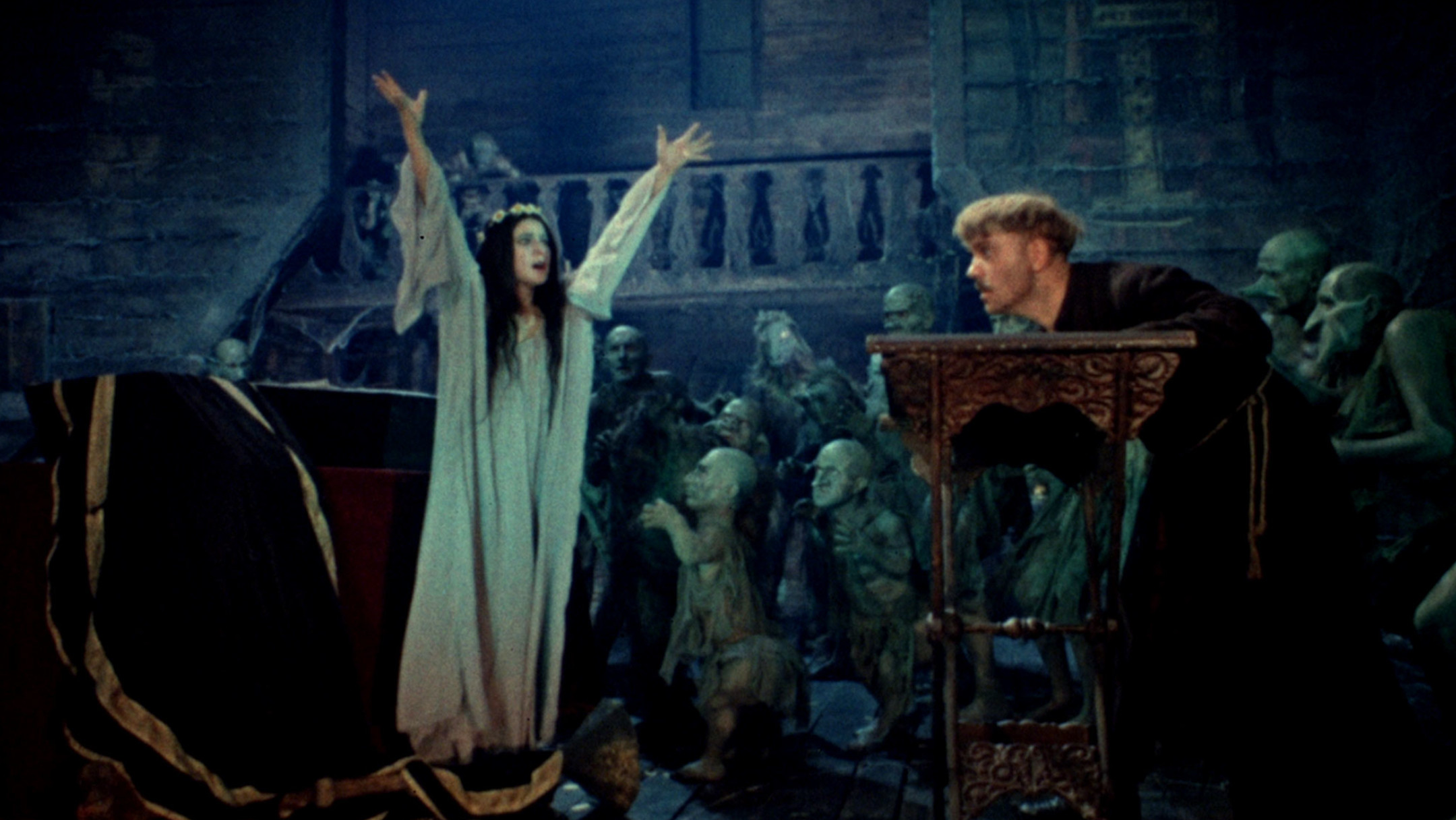
When I watched Viy for the first time, I knew I’d found it. The film was unlike anything I’d seen: witches flying across the Ukrainian countryside, demons clawing their way out of church walls, and finally the monstrous Viy himself, whose eyelids drag along the floor until his minions lift them with pitchforks so he can unleash his deadly gaze.
It was grotesque, funny, gothic, folkloric — and, crucially, it had a history. Among people who care about special effects and puppetry, Viy has a certain legendary status. It felt like the perfect candidate for re-scoring and re-staging.
So we applied for funding, and with support from Film Hub South West through the BFI Film Audience Network, the project was born.
I brought in longtime collaborator Rusty Sheriff, a sonic artist with a taste for the uncanny. Rusty builds soundscapes out of hacked toys, electromagnetic waves, broken circuits, and field recordings. His new score stripped out the original soundtrack of Viy and replaced it with a dense, eerie audio narrative that breathed new life into the storyworld.
We planned it all, booked the venues, and were ready to announce. Everything was lined up.
And then the invasion happened.
War, Politics, and a Pause
The very day before we released our marketing materials, Russian tanks crossed the border into Ukraine. Overnight, the film felt politically toxic. On the surface, Viy was a Soviet horror film made at Mosfilm, the great Russian studio. To promote it in the weeks after the invasion would have looked tone-deaf.
We pulled the plug.
It was a frustrating decision — the work was ready, the momentum was there — but it was also the right one. At that moment, staging a “Russian” film in Britain felt unthinkable.
And yet, shelving the project forced me to go back to the film, to dig deeper into its origins. What I found transformed the way I thought about Viy.
Ukrainian Roots
Although often labelled a Russian classic, Viy is profoundly Ukrainian.
Nikolai Gogol, the author of the original story, was born and raised in Ukraine. His tale begins with students from a Kyiv seminary. Its landscape is Ukrainian, its folklore drawn from local traditions, its very title rooted in the Ukrainian word вій (viy), meaning eyelash or eyelid.
Even the film’s hidden architect, Aleksandr Ptushko — the “Soviet Walt Disney” — was born in Luhansk, now eastern Ukraine. Though he lived and worked in Moscow, his fingerprints are everywhere: co-writing the screenplay, lobbying Mosfilm to approve the project, and directing many of the most technically complex sequences.
In my conversations with Mosfilm, their position was clear: Viy is Russian. But I disagree. To me, Viy belongs to Ukraine — its storyworld, its language, its folklore, its creative DNA. In the context of the ongoing war, reclaiming that identity matters.
“We must fight for Gogol… First the Muscovites stole our history, then they colonised us, and now this war continues to annihilate my people while Russian propaganda exploits our culture.” — Professor Nataliya Torkut
Folklore or Invention?
So what exactly is Viy, this monstrous figure with dragging eyelids and a deadly stare?
Gogol claimed he was transcribing authentic Ukrainian folklore, describing Viy as “the chief of the gnomes in Little Russian legend.” Modern scholars disagree. No such being exists in Slavic folklore under that name. Instead, Gogol seems to have created Viy out of fragments: the “evil eye” of Indo-European myth, Balor of Irish legend, Slavic spirits like rusalki and witches.
That’s the genius of Gogol. His Viy is not a piece of folklore in the strict sense. He is a literary invention, but one so steeped in folkloric motifs that he feels ancient, like something you half-remember from the edge of childhood fears.
It’s this mixture — part genuine folk belief, part gothic imagination — that has made Viy endure for nearly two centuries.
When Viy hit Soviet screens in 1967, it was hailed as the first officially sanctioned horror film in the USSR. Horror as a genre was taboo under Soviet censorship. The only way it could be made was by disguising it as folklore.
Ptushko’s involvement helped. As a master of fantasy cinema, his name reassured the censors that this was cultural, not decadent. Archival evidence and set photographs suggest he directed much of the film himself, particularly the unforgettable final night in the chapel when all hell literally breaks loose.
The result is a film both groundbreaking and compromised — at once a piece of Soviet cinema and something that resists Soviet categorisation. Its Ukrainian roots made it folkloric, but its grotesque imagery made it horror. That tension is what gives Viy its unique charge.
False Starts and New Beginnings
For months after the invasion, our version of Viy sat on the shelf. We had built it, but couldn’t show it.
Finally, in May 2025, we staged a modest performance at Birmingham’s Flatpak Festival. Rusty performed the score live to a small but appreciative audience. It proved the concept: Viy could live again through sound.
Now, at last, we are preparing for a full staging. On Halloween 2025, Viy will come to Portsmouth’s historic Treadgold Building.
This will not be just a film with a new soundtrack. We’re building it as an immersive experience:
- Scare acting workshops to recruit and train performers who can embody the spirits and witches of Gogol’s tale.
- Set designers and musicians to transform the venue into a haunted seminary.
- An audience journey that places spectators inside the circle of chalk, making them participants in the storyworld rather than passive viewers.
Why Viy Matters Now
So why pursue this film after all the setbacks? For me, three reasons stand out:
First, Viy is a hidden gem of world cinema. It deserves rediscovery.
Second, it’s a perfect canvas for live cinema — uncanny, experimental, visually rich.
Third, it matters politically. To present Viy as Ukrainian folk horror is an act of cultural recognition. It challenges the Russian narrative that claims Gogol and his creations as theirs. It honours Ukrainian culture at a moment when it is under assault.
“How could great Russian literature ‘emerge’ from the work of a Ukrainian? That question threatens to unravel their whole narrative. Which is why we must fight for Gogol.” — Professor Nataliya Torkut
Entering the Circle
When audiences step into the Treadgold Building this Halloween, they will not simply watch a film. They will enter a circle of chalk, just as Khoma Brut does in Gogol’s story, and face the spirits that gather in the dark.
They will encounter a story that began as folklore, was reshaped as literature, refashioned as Soviet cinema, and is now being reborn as immersive live performance.
And in doing so, they will also encounter a deeper truth: that culture is never neutral. Stories carry identities, and identities can be stolen, silenced, or reclaimed.
This is why Viy matters. Not just as a piece of folk horror, not just as a curiosity of Soviet cinema, but as a Ukrainian story — one that insists on being heard, seen, and lived.
So this Halloween, dare to enter the circle. But know that when you do, you’re stepping into more than a horror film. You’re stepping into a struggle over history, identity, and the power of stories to survive.
BOOK YOUR TICKET HERE!